

- industrial air compressor
- desiccant compressed air dryer
- diesel air compressor
- large vacuum pump
- oil free piston air compressor
- oil free screw air compressor
- oil free scroll air compressor
- pm vsd dual stage screw air compressor
- pm vsd single stage screw air compressor
- refrigerated air dryer
- screw blower
- single stage double screw air compressor
- two stage double screw air compressor
- ultra high pressure air compressor


 English
  Français
  Tiếng Việt
  Italiano
  Nederlands
  Türkçe
  Svenska
  Polski
  Română
  Latviešu
  한국어
한국어  Русский
  Español
  Deutsch
  Українська
  Português
  العربية
  Indonesian
  Čeština
  Suomi
Suomi  Eesti
Eesti  Български
  Dansk
Dansk  Lietuvių
  Bokmål
  Slovenčina
  Slovenščina
  Ελληνικά
  Magyar
  עברית
עברית 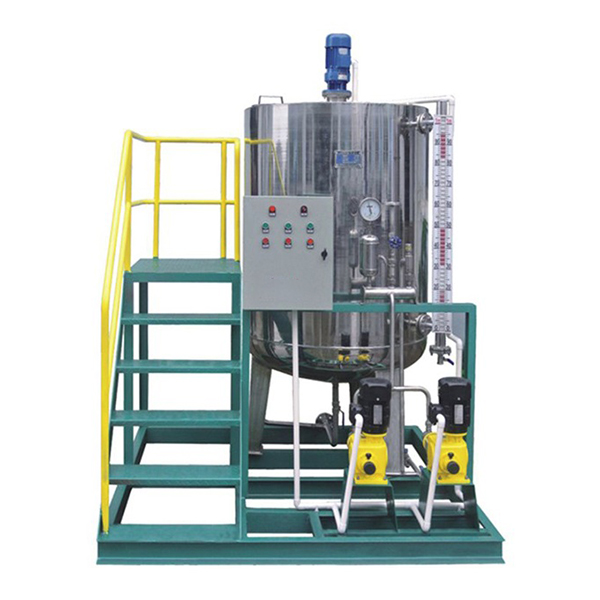
corrosion and scale inhibitor dosing unit for power plants
The design and use principle of corrosion and scale inhibitor dosing unit is based on the water quality control of circulating cooling system, the main purpose is to prevent scale formation and reduce corrosion by adding chemicals.
Description
This corrosion and scale inhibitor dosing unit is an important equipment in modern industrial water treatment, applicable to large-scale circulating cooling water system, used to extend the service life of the equipment and improve the operational efficiency of the system.
1. Process Principle
Corrosion and scaling: Industrial circulating cooling water systems, due to long-term operation, water hardness, alkalinity, pH, concentration cycles, and environmental conditions (such as temperature, humidity), are prone to scale deposition and corrosion of metal equipment. Scaling affects heat exchange efficiency and can cause equipment failure; corrosion may damage pipes, pumps, and other key components, reducing system safety.
Pharmaceutical dosing: To prevent these problems, it is necessary to manually or automatically add corrosion inhibitors and scale inhibitors to the circulating water. Common agents include polyphosphates, zinc salts, polyacrylates, and acidic corrosion inhibitors. These agents chemically react with dissolved components in the water to inhibit scale formation and form a protective film on metal surfaces to reduce corrosion rates.
2. Process Overview
- Liquid dissolution system: Includes a solvent dissolution tank and mixing device. Solid chemicals (corrosion and scale inhibitors) are added to the tank and mixed with circulating water to form a suitable solution.
- Measuring and dosing system: Accurately controls and delivers the required dosage of chemicals to the cooling water system dosing point. Equipped with flow meters, proportional adjustment devices, and pumps to ensure accurate dosing matched to water volume.
- Safety system: Includes concentration detection, flow monitoring, pressure protection, and other devices to ensure stable operation during dosing and to respond to abnormalities promptly.
- Control system: Supports manual or automatic control. Automatic control uses upper system (DCS or PLC) signals to adjust dosage and ensure water quality meets process requirements.
3. Scope of Application
- Thermal power generation: Cooling circulating water systems in thermal power plants typically involve high temperature and hard water, easily causing scaling and corrosion. Continuous dosing maintains system stability.
- Petrochemical: Petrochemical enterprises have similar cooling water systems, especially with high dissolved solids and oil/gas substances, requiring effective scale and corrosion inhibition treatment.
4. Advantages
- Improve system efficiency: Effective scale and corrosion inhibition improves heat exchange efficiency and reduces energy loss due to scaling and corrosion.
- Extend equipment life: Regular agent dosing prevents equipment surface corrosion, extending service life.
- Automation control: Automation improves dosing accuracy and flexibility, reduces manual intervention, and enhances system reliability.