

- industrial air compressor
- desiccant compressed air dryer
- diesel air compressor
- large vacuum pump
- oil free piston air compressor
- oil free screw air compressor
- oil free scroll air compressor
- pm vsd dual stage screw air compressor
- pm vsd single stage screw air compressor
- refrigerated air dryer
- screw blower
- single stage double screw air compressor
- two stage double screw air compressor
- ultra high pressure air compressor


 English
  Français
  Tiếng Việt
  Italiano
  Nederlands
  Türkçe
  Svenska
  Polski
  Română
  Latviešu
  한국어
한국어  Русский
  Español
  Deutsch
  Українська
  Português
  العربية
  Indonesian
  Čeština
  Suomi
Suomi  Eesti
Eesti  Български
  Dansk
Dansk  Lietuvių
  Bokmål
  Slovenčina
  Slovenščina
  Ελληνικά
  Magyar
  עברית
עברית 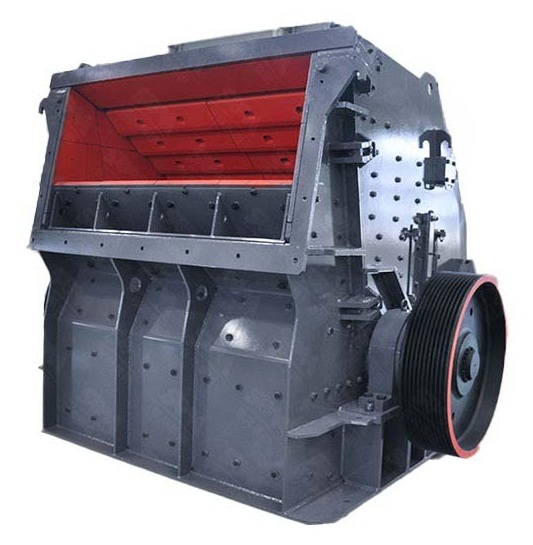
large capacity impact crusher produces 150 to 2000ton/h
This large capacity impact crusher is a newly designed crushing equipment specially designed to meet customers’ demand for high efficiency, low cost, energy saving and consumption reduction, which is widely used in mining, metallurgy, cement and other industrial sectors.
Description
This impact crusher is suitable for coarse and medium crushing production line with large handling capacity, which is a good choice for high performance crushing equipment.
Features of Large Capacity Impact Crusher:
- High-precision Heavy-duty Rotor: It adopts high-precision heavy-duty rotor with large rotational inertia, equipped with high-quality bearings to ensure rotor precision and high bearing capacity, so that the material can be fully accelerated during crushing and the crushing ratio can be increased, which will enhance the production efficiency.
- Full hydraulic operating system: Equipped with multi-functional full hydraulic operating system, with high adjustment precision and fast response speed, it is convenient for the replacement and maintenance of the plate hammer and impact block, and it can precisely adjust the granularity of the discharged material, which can effectively reduce the cost of labor and time.
- Involute crushing cavity design: The use of involute cavity design ensures that the material is impacted vertically by the impact plate during the crushing process, which enhances the number of strikes, improves the crushing efficiency, and improves the grain size of the material.
- Digital control system: The use of advanced digital control technology, to ensure that the processing accuracy meets the standard, so that the accuracy of the core components to meet even higher requirements, to enhance the stability and reliability of the equipment.
- High-strength structure design: The casing is made of high-strength steel, the plate hammer uses wear-resistant materials, the rotor is made of low-temperature-resistant, high-strength steel, and the bearings are made of international brands, which ensures the durability and service life of the equipment. Thickened liner design and bolt rotation from the outside to the inside, effectively avoiding the bolt wear caused by the loosening of the side guard plate, improve the service life of the side guard plate.
Working Principle of Large Capacity Impact Crusher:
Impact crusher crushes materials through impact energy. When the material enters the plate hammer area, it is crushed by the high-speed impact of the plate hammer, and is thrown to the counterattack device installed above the rotor, and is crushed again by the impact. Then, the crushed materials rebound from the impact liner and re-enter the plate hammer area for further crushing. This process continues to circulate until the material reaches the required particle size and is discharged through the lower part of the equipment. Adjusting the gap between the impact frame and the rotor frame can adjust the particle size and shape of the material.
In addition, the equipment is equipped with a spring-loaded safety device to avoid damage when non-crushed material enters the crushing chamber. When non-crushed material enters, the impact frame will back up and the non-crushed material is discharged, thus resuming normal operation and preventing the equipment from jamming.
Applicable materials of large capacity impact crusher: Impact crusher is suitable for crushing many kinds of ores and non-mineral materials, such as: limestone, calcite, feldspar, talc, barite, dolomite, kaolin, gypsum, graphite and so on.
The capacity of Large Capacity Impact Crusher: 150 tons/hour to 2000 tons/hour, depending on the hardness of the material and the model of the equipment, the specific capacity varies.
Application areas of large capacity impact crusher:
- Mining and metallurgical industry: used for crushing all kinds of ores, including limestone, calcite, feldspar, etc. It is a common crushing equipment in the process of ore mining and smelting.
- Cement and construction engineering: widely used in cement production line, building stone crushing, mechanism sand production and other fields, especially suitable for high hardness stone processing.
- Chemical and refractory materials: in the production of refractory materials, fertilizers and other products, impact crusher can efficiently process different types of raw materials.
- Other industrial applications: including power, smelting and other heavy industrial sectors, it can also be used for material processing in infrastructure projects such as highway and bridge construction.
Technical Parameters
| Model | Rotor specification | Feed opening | Max feeding size | Capacity(ton/h) | Motor power | Dimensions(wxdxh) |
|---|---|---|---|---|---|---|
| CI1110 | 1100x1000mm | 1020x820mm | 500mm | 110 to 260 | 160 to 200kw | 2626x2106x1945mm |
| CI1213 | 1200x1300mm | 1320x880mm | 550mm | 145 to 350 | 200 to 250kw | 2809x2529x2091mm |
| CI1315 | 1300x1500mm | 1540x930mm | 600mm | 200 to 450 | 250 to 315kw | 2819x2535x2412mm |
| CI1520 | 1500x2000mm | 2040x995mm | 400mm | 335 to 760 | 400 to 500kw | 3390x3520x2790mm |
| CI1524 | 1500x2400mm | 2516x767mm | 400mm | 410 to 960 | 560 to 630kw | 3434x3955x2821mm |
| CI1630 | 1600x2700mm | 2740x787mm | 400mm | 540 to 1250 | 710 to 800kw | 3693x4520x3173mm |
| CI1313 | 1300x1300mm | 1320x1225mm | 800mm | 280 to 520 | 200 to 250kw | 2963x2560x2611mm |
| CI1415 | 1400x1500mm | 1540x1320mm | 900mm | 340 to 650 | 250 to 315kw | 3325x2804x3068mm |
| CI1620 | 1600x2000mm | 2040x1630mm | 1100mm | 500 to 1050 | 400 to 500kw | 3899x3692x3598mm |
| CI2023 | 2000x2300mm | 2310x1990mm | 1300mm | 1000 to 2100 | 1000 to 1260kw | 4890x4330x4765mm |