

- industrial air compressor
- desiccant compressed air dryer
- diesel air compressor
- large vacuum pump
- oil free piston air compressor
- oil free screw air compressor
- oil free scroll air compressor
- pm vsd dual stage screw air compressor
- pm vsd single stage screw air compressor
- refrigerated air dryer
- screw blower
- single stage double screw air compressor
- two stage double screw air compressor
- ultra high pressure air compressor


 English
  Français
  Tiếng Việt
  Italiano
  Nederlands
  Türkçe
  Svenska
  Polski
  Română
  Latviešu
  한국어
한국어  Русский
  Español
  Deutsch
  Українська
  Português
  العربية
  Indonesian
  Čeština
  Suomi
Suomi  Eesti
Eesti  Български
  Dansk
Dansk  Lietuvių
  Bokmål
  Slovenčina
  Slovenščina
  Ελληνικά
  Magyar
  עברית
עברית 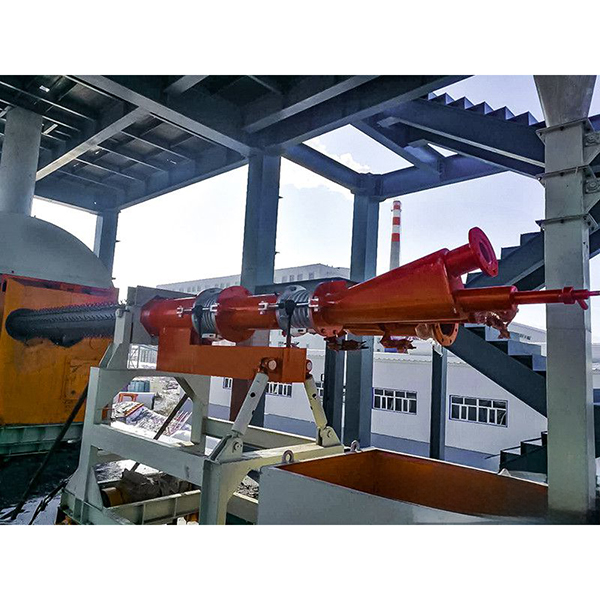
pulverized coal burner with adjustable duct outlet area
The pulverized coal burner integrates fuel delivery, air proportioning and combustion control, and is an important core device of modern rotary kiln, boiler and other large-scale industrial furnace and kiln systems.
Description
The pulverized coal burner mainly consists of piping system, nozzle group, butterfly valve regulator, metal corrugated compensator, pressure monitoring device and fire-resistant protection layer, and each air duct outlet is equipped with adjustable function to realize flexible and precise air distribution.
Depending on the model, the coal feeding capacity of a single burner ranges from 1.2 tons per hour to 6.5 tons per hour, which can be matched to the rotary kiln with a diameter of 1.9 m to 4.0 m. It is widely used in many industrial production lines.
Characteristics of pulverized coal burner:
- Multi-duct composite structure (axial wind, coal wind, cyclone wind, center wind), the air volume can be independently adjusted
- The main body of the equipment is made of heat-resistant steel, the front end is high temperature resistant, and the tail end can be equipped with refractory castable material.
- With oil gun channel, support auxiliary fuel ignition
- Adapt to a variety of coal types, including poor quality coal, low volatile coal and anthracite.
- Complete models to meet the needs of different sizes and working conditions
Advantages of pulverized coal burner:
- Stable and complete flame shape, flame size, strength and weakness can be adjusted online, accurately match the kiln needs
- High combustion efficiency, high fuel utilization, significantly reduce energy consumption
- Reduce nitrogen oxide (NOx) emissions, help to meet environmental standards
- Strong adaptability, a wide range of fuel types, suitable for production lines with frequent fluctuations in coal quality
- Easy operation, flexible adjustment of air volume and flame, easy maintenance, high operational reliability.
Working principle of pulverized coal burner:
The pulverized coal burner realizes the full combustion of pulverized coal through the synergistic effect of four winds. The pulverized coal is sprayed into the kiln from the burner with the help of coal wind, and the cyclone wind cuts in at a certain angle, so that the pulverized coal is fully dispersed and uniformly distributed in the airflow to enhance the combustion reaction. The axial wind concentrates the flame, ensures strong flame closing and improves thermal efficiency; the central wind further stabilizes the flame core and enhances combustion stability.
In the operation process, the operator can adjust the butterfly valve of each duct to flexibly control the flame length and thickness:
- Increase the cyclone wind, improve the flame expansion.
- Adjust the axial flow wind, control the flame length.
- Expansion and contraction of the center duct, fine-tuning the flame shape and stability.
- The three winds dynamically cooperate to accelerate the ignition and complete combustion of pulverized coal, to ensure uniform temperature distribution in the kiln and improve thermal efficiency.
Application areas:
- Building materials industry: cement plant rotary kiln, lime kiln
- Metallurgical industry: iron and steel plant heating furnace, pellet roasting
- Electric power industry: coal-fired boiler auxiliary combustion
- Chemical industry: coal gasifier, drying equipment
- Other fields: glass kiln, ceramic firing kiln
Fuel adaptability and environmental performance, so that it has become a lot of industrial high-temperature thermal process equipment.