

- industrial air compressor
- desiccant compressed air dryer
- diesel air compressor
- large vacuum pump
- oil free piston air compressor
- oil free screw air compressor
- oil free scroll air compressor
- pm vsd dual stage screw air compressor
- pm vsd single stage screw air compressor
- refrigerated air dryer
- screw blower
- single stage double screw air compressor
- two stage double screw air compressor
- ultra high pressure air compressor


 English
  Français
  Tiếng Việt
  Italiano
  Nederlands
  Türkçe
  Svenska
  Polski
  Română
  Latviešu
  한국어
한국어  Русский
  Español
  Deutsch
  Українська
  Português
  العربية
  Indonesian
  Čeština
  Suomi
Suomi  Eesti
Eesti  Български
  Dansk
Dansk  Lietuvių
  Bokmål
  Slovenčina
  Slovenščina
  Ελληνικά
  Magyar
  עברית
עברית 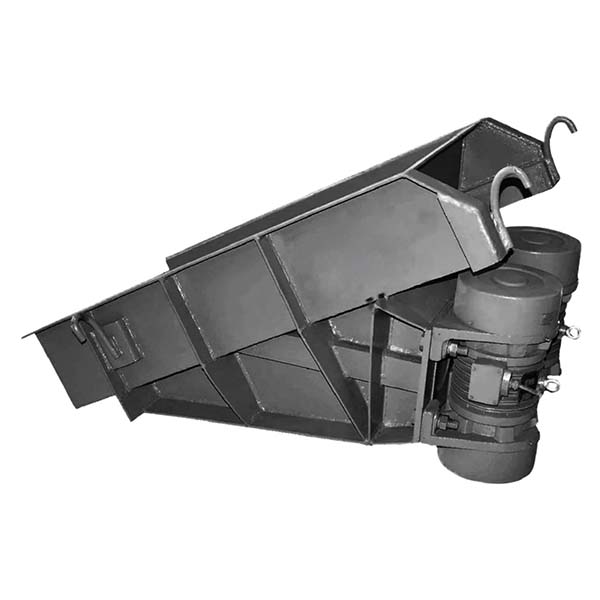
vibrating feeder for combined crushing and screening plants
Vibrating feeder is a kind of high-efficiency feeding device that conveys lumpy, granular or powdery materials from the silo or hopper to the downstream equipment in a stable, continuous and quantitative way with the help of mechanical excitation produced by vibration source.
Description
Vibrating Feeder Overview
Vibrating feeder is not only suitable for feeding jaw crusher, impact crusher, cone crusher, and other hosts, but also widely used in mineral processing, coal beneficiation, chemical batching, grain processing, packaging, conveying, and more. It undertakes tasks such as feeding, metering, dosing, pre-screening, and grading.
Features of Vibrating Feeder
- Stable vibration, reliable performance: Utilizes symmetrical double eccentric shaft or electromagnetic vibration mode for uniform, smooth material conveying.
- Linear trajectory design: Material advances in a straight line, with a controllable path for accurate feeding and screening.
- Compact structure, flexible adjustment: Small size, flexible installation, and freely adjustable bar gap and amplitude.
- Bar anti-clogging design: Bar structure effectively prevents clogging from wet or viscous materials.
- Low noise and environmental protection: Good noise control, with shock absorbing springs for effective vibration isolation and improved operation environment.
- Wear-resistant liner configuration: Extends the equipment’s service life, suitable for high-intensity load conditions.
Advantages of Vibrating Feeder
- High adaptability: Handles different particle sizes, humidity, and viscosity, including wet ore, wet coal, slag, etc.
- Strong compatibility with automation: Can connect to industrial automation systems for intelligent feeding, flow monitoring, and remote start/stop.
- Energy-saving design: Low power consumption, vibration uses self-synchronization to effectively reduce energy loss.
- Simple maintenance: Key components are easy to disassemble and install, ensuring easy maintenance and low operating costs.
- Double function: Provides both feeding and primary screening, saving investment with a multi-purpose machine.
Working Principle of Vibrating Feeder
The core driving part is the vibration source—usually a double eccentric shaft or electromagnetic exciter. The vibration source drives the trough to produce periodic reciprocating vibration, forcing material to make parabolic jumping movement in the trough and move forward uniformly along the inclined surface. The grating area is adjustable, allowing fine particles to be screened out before reaching the main crusher, improving host efficiency and providing primary screening and debris removal. Excitation force, vibration frequency, angle, and other parameters can be finely controlled to dynamically adjust conveying speed and screening effect.
Application Areas of Vibrating Feeder
- Mines and quarries: Feeding before rough crushing, handling metal ores, non-metallic ores, sand, and gravel aggregates.
- Coal and coal processing plants: Continuous feeding and pre-treatment screening for raw, lump, and screened coal.
- Cement and building materials industry: Conveying limestone, clinker, gypsum, and other raw materials for grinding and crushing lines.
- Metallurgical smelting system: Conveying furnace charge, ore, coke, etc. to blast or electric furnaces and other smelting equipment.
- Chemical industry and batching: Automatic batching and conveying of granular chemicals, such as fertilizers and powder additives.
- Grain and light industry: Automatic feeding and screening for soybeans, wheat, feed, and other particles.
- Ports and logistics systems: Bulk material transportation during shipping, railroad loading, and unloading processes.