

- industrial air compressor
- desiccant compressed air dryer
- diesel air compressor
- large vacuum pump
- oil free piston air compressor
- oil free screw air compressor
- oil free scroll air compressor
- pm vsd dual stage screw air compressor
- pm vsd single stage screw air compressor
- refrigerated air dryer
- screw blower
- single stage double screw air compressor
- two stage double screw air compressor
- ultra high pressure air compressor


 English
  Français
  Tiếng Việt
  Italiano
  Nederlands
  Türkçe
  Svenska
  Polski
  Română
  Latviešu
  한국어
한국어  Русский
  Español
  Deutsch
  Українська
  Português
  العربية
  Indonesian
  Čeština
  Suomi
Suomi  Eesti
Eesti  Български
  Dansk
Dansk  Lietuvių
  Bokmål
  Slovenčina
  Slovenščina
  Ελληνικά
  Magyar
  עברית
עברית 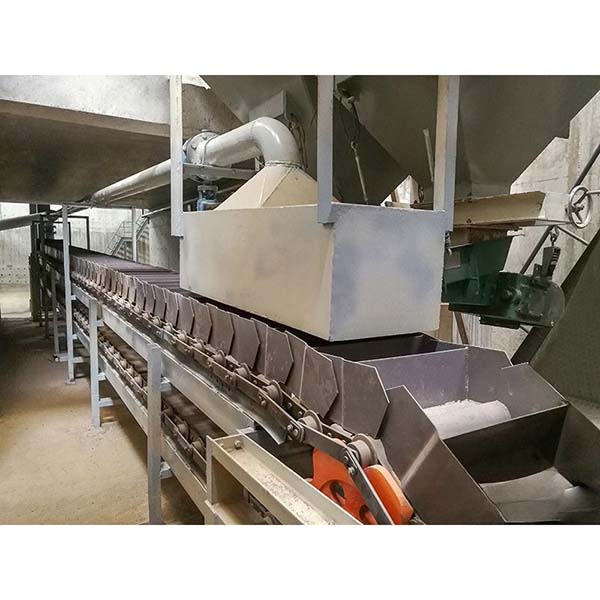
apron conveyor with plate chain as traction element
Apron conveyor adopts plate chain as the traction element and combines with the structure of scale plate hopper, which makes the equipment able to run stably at a large inclination angle, with strong load capacity and long conveying distance.
Description
Apron conveyor not only plays an important role in the transportation of materials, but also can complete some process requirements, such as material cooling, cleaning, etc. It is widely used in occasions that need to transport large, high temperature or scorching materials.
Main features of apron conveyor:
- High strength and high temperature resistance: The design of apron conveyor makes it able to withstand high loads and transport high-temperature materials, suitable for the transportation of materials from 600°C to 700°C.
- Larger inclination angle and bending radius: It can operate in the range of 30° to 35° inclination angle, and the bending radius is adjustable, usually 3 meters to 5 meters, which can adapt to different working environments and layout requirements.
- Compact structure: The whole machine structure design is compact, occupies little space, easy to install and debug, and the overall operation of the equipment is simple.
- Wear-resistant, good stability: Scale plate hopper is made of wear-resistant steel stamping, with small error, smooth operation and strong adaptability. Able to handle large, hot materials, not easy to damage.
- Simple maintenance, durability: The equipment has fewer wearing parts, and easy to replace, to ensure the efficient operation of the equipment for a long time.
Core advantages of apron conveyor:
- High efficiency and load capacity: The apron conveyor can complete the material transportation in a longer conveying distance, and has a strong carrying capacity, can efficiently handle large materials.
- Adapt to high-temperature environment: The conveyor can carry high-temperature material transportation, suitable for metallurgy, electric power and chemical industry in the high-temperature operation needs.
- Flexibility and stability: Whether horizontal or inclined conveying, apron conveyor can provide stable and reliable conveying effect, and adaptability, can cope with a variety of complex working conditions.
- Low maintenance costs: Compact structure, and reduces the number of wearing parts, reduces the maintenance and replacement costs, and improves work efficiency.
The working principle of apron conveyor:
Through the plate chain as a traction mechanism, its strong traction force and wear resistance is utilized to drive the scale plate hopper attached to the chain to move. When the transmission device starts, the chain is driven by the sprocket, and the chain meshes with the sprocket, making the scale sheet hopper attached to the chain move along the track. The hopper receives the material from the inlet and conveys it to the outlet through the continuous movement of the chain. Under the action of gravity and centrifugal force, the material is discharged and goes to the next process. Through the continuous movement of the chain, the apron conveyor can efficiently and continuously convey large lumps of materials, scorching materials and so on.
Application fields of apron conveyor:
- Metallurgical industry: Suitable for conveying high-temperature molten metal, ore, slag and other materials, widely used in the metallurgical production line of iron and steel plants, aluminum plants and so on.
- Electric power industry: Used for conveying coal, ash and other high temperature materials, such as power plant boilers and coal conveyor system.
- Chemical industry: Suitable for conveying powdery, granular or lumpy chemical raw materials, fertilizers, plastics and rubber manufacturing and other fields.
- Building materials industry: In the cement factory, brick factory and other building materials industry, apron conveyor can be used for conveying lime, sand, gravel, soil and other large materials.
- Other high temperature material conveying: Also used in other industries that need to deal with scorching or fragile materials, such as ceramics, glass manufacturing and other fields.