

- industrial air compressor
- desiccant compressed air dryer
- diesel air compressor
- large vacuum pump
- oil free piston air compressor
- oil free screw air compressor
- oil free scroll air compressor
- pm vsd dual stage screw air compressor
- pm vsd single stage screw air compressor
- refrigerated air dryer
- screw blower
- single stage double screw air compressor
- two stage double screw air compressor
- ultra high pressure air compressor


 English
  Français
  Tiếng Việt
  Italiano
  Nederlands
  Türkçe
  Svenska
  Polski
  Română
  Latviešu
  한국어
한국어  Русский
  Español
  Deutsch
  Українська
  Português
  العربية
  Indonesian
  Čeština
  Suomi
Suomi  Eesti
Eesti  Български
  Dansk
Dansk  Lietuvių
  Bokmål
  Slovenčina
  Slovenščina
  Ελληνικά
  Magyar
  עברית
עברית 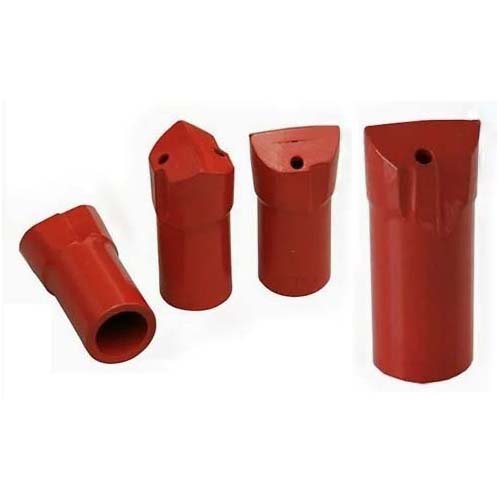
7 degree taper chisel drill bit with tungsten carbide
The 7-degree taper chisel drill bit is suitable for drilling small holes in soft to medium-hard rock and is typically used with air-powered rock drills such as the Y24 and YT28.
Description
Key Features:
- This taper drill bit is forged from 45CrNiMoV alloy steel, offering higher toughness and effectively preventing breakage of the 7 degree taper chisel drill bit.
- Designed with flushing holes to efficiently discharge cuttings, waste fluid, and air bubbles, preventing jamming.
- 7 degree taper angle for a tight fit with taper drill rods, ensuring efficient operation.
Technical Specifications of 7 Degree Taper Chisel Drill Bit
- Bit diameter: 32 mm, 34 mm, 36 mm, 38 mm, 40 mm, 42 mm, and 43 mm available
- Tungsten carbide inserts: 13×8 mm, 15×8 mm, 13×9 mm, 15×10 mm, and 17×10 mm available
- Taper: 7 degree
- Weight: 0.2 kg to 0.5 kg
Recommendations for Use
- Ensure the taper bore of the bit and the taper of the drill rod are clean, and both are 7 degree taper.
- Ensure sufficient flushing water and air pressure to remove cuttings, waste fluid, and air bubbles, and to cool the bit.
- Allow the bit to cool naturally. Do not quench it in cold water to prevent thermal cracking.
- If the taper surface is abnormal, regrind immediately to prevent stress fracture.
- The bit diameter should match the drill rod requirements.
Main Applications
7 degree taper chisel drill bits are widely used for small-hole blasting drilling in underground mines, and for small-diameter drilling in marble, granite, and aggregate production.
FAQ (Frequently Asked Questions)
Should I choose a chisel bit or a button bit?
Taper chisel drill bits are suitable for small-hole drilling in soft to medium-hard rock. They are lower in cost and easier to regrind the cutting edge. Taper button drill bits are used for very hard or highly abrasive rock such as granite. They offer higher drilling efficiency and greater durability.
Should I choose a 7-degree, 11-degree, or 12-degree taper drill bit?
The taper angle of the taper drill bit must exactly match the taper angle of the drill rod you are using. If you do not know the exact taper, check the markings on your drill rod or equipment, or measure the rod’s taper, length, and shank diameter. Using a mismatched taper will result in damage to the bit or the rod. Typically, 7-degree taper drill bits are used for lightweight, handheld rock drills such as the YT24 or Y26, mainly for small-hole drilling.
What is the 3mm rule for regrinding taper chisel drill bits?
When the width of the wear flat on the cutting edge of the taper chisel drill bit reaches 3mm, the tungsten carbide edge should be reground. Continuing to use a blunt bit will increase stress on the chisel bit, which may lead to the bit fracturing.
Can this taper chisel drill bit be used with both air and water flushing?
Absolutely. The 7 degree taper chisel drill bit is designed with flushing holes, allowing for efficient discharge of cuttings, waste fluid, and air bubbles, preventing the bit from overheating or jamming during operation.
How can I prevent the carbide insert from falling out of the drill bit?
Make sure the taper of the drill bit and the drill rod are perfectly matched for a tight fit. Always use flushing fluid and never drill dry. These practices can prevent the drill bit from overheating and reduce the risk of the carbide insert falling out during operation.
Technical Parameters 1
| Taper bit, Insert | D | Insert H x T | Taper | Order number | Weight kg | |
|---|---|---|---|---|---|---|
| mm | inch | |||||
 Chisel | 32 | 1 1/4 | 13 x 8 | 7 degree | B118-3213-2710 | 0.2 |
| 15 x 8 | B118-3215-2710 | 0.2 | ||||
| 34 | 1 11/32 | 13 x 8 | 7 degree | B118-3413-2710 | 0.3 | |
| 15 x 8 | B118-3415-2710 | 0.3 | ||||
| 36 | 1 13/32 | 13 x 8 | 7 degree | B118-3613-2710 | 0.3 | |
| 15 x 8 | B118-3615-2710 | 0.3 | ||||
| 38 | 1 1/2 | 13 x 9 | 7 degree | B118-3813-2710 | 0.3 | |
| 15 x 10 | B118-3815-2710 | 0.3 | ||||
| 17 x 10 | B118-3817-2710 | 0.4 | ||||
| 40 | 1 9/16 | 13 x 9 | 7 degree | B118-4013-2710 | 0.3 | |
| 15 x 10 | B118-4015-2710 | 0.4 | ||||
| 17 x 10 | B118-4017-2710 | 0.4 | ||||
| 42 | 1 5/8 | 13 x 9 | 7 degree | B118-4213-2710 | 0.4 | |
| 15 x 10 | B118-4215-2710 | 0.4 | ||||
| 17 x 10 | B118-4217-2710 | 0.5 | ||||
| 43 | 1 5/8 | 13 x 9 | 7 degree | B118-4313-2710 | 0.4 | |
| 15 x 10 | B118-4315-2710 | 0.4 | ||||
| 17 x 10 | B118-4317-2710 | 0.5 | ||||
Technical Parameters 2
| Feature | Taper Chisel Bit | Taper Button Bit |
|---|---|---|
| Design | Single wedge-shaped carbide blade | Multiple hemispherical or conical carbide buttons |
| Best Rock Type | Soft to Medium-Hard (e.g., Limestone, Sandstone) | Hard to Very Hard & Abrasive (e.g., Granite, Basalt, Quartzite) |
| Drilling Speed | Very fast in soft rock; slows significantly in hard rock | Consistent high penetration rates across various rock types |
| Hole Straightness | Prone to deviation in fractured / broken ground | Excellent stability; straighter, cleaner holes |
| Flushing Efficiency | Moderate to poor: Larger, flatter cuttings can clog in fractured rock; more regrinding of debris | Superior: Smaller, uniform cuttings + better exposure of flushing paths → faster cuttings removal, less clogging, cooler bit operation |
| Maintenance | High: Frequent regrinding required to maintain sharp edge | Low to maintenance-free; much less frequent grinding needed |
| Initial Cost | Lower: Economical for small-scale or budget projects | Higher upfront but longer service life & lower cost per meter |
| Risk of Jamming | Higher risk in fissured or broken rock | Lower risk due to multiple contact points & better flushing |